

With the increasing diversity of mobile storage products, retractable USB flash drives have become a preferred choice for many individual and enterprise users due to their advantages such as capless design, self-protected interface, and portability. However, faced with products of varying specifications, materials, and performance on the market, making a reasonable choice to ensure user experience and data reliability requires comprehensive consideration of several key factors.
First, pay attention to the interface type and transmission performance. Retractable USB flash drives generally use USB standards, covering versions such as USB 2.0, USB 3.0, USB 3.1, and USB 3.2. USB 3.0 and above have significantly higher theoretical bandwidth and actual transmission speeds than USB 2.0, which can greatly reduce the copying time of large files. When purchasing, consider your own usage scenarios. For example, users who frequently transfer high-definition videos, engineering files, or perform batch data backups should prioritize products that support USB 3.0 or above and indicate stable speeds. If you mainly use it for temporary storage of small files and do not have high speed requirements, you can choose the appropriate specification based on your budget. Simultaneously, attention should be paid to the interface type. Some newer devices have adopted Type-C or multi-protocol compatible composite interfaces, improving compatibility with smartphones, tablets, and other terminals.
Secondly, the reliability and ergonomics of the telescopic structure need to be evaluated. The telescopic mechanism is the core design of a retractable USB flash drive, commonly available in two types: sliding rail and spiral. Sliding rail structures emphasize smooth pushing and pulling and precise positioning, suitable for users seeking intuitive operation; spiral structures offer advantages in torsion resistance and dust resistance, suitable for use in harsher or dusty environments. Regardless of the type, the precision and durability of the materials should be considered. High-quality products use wear-resistant metal or high-strength engineering plastic rails and undergo multiple cycle tests to verify their lifespan. When purchasing, it's advisable to try it out to feel whether the resistance is uniform and the rebound is adequate, to determine its stability under long-term use.
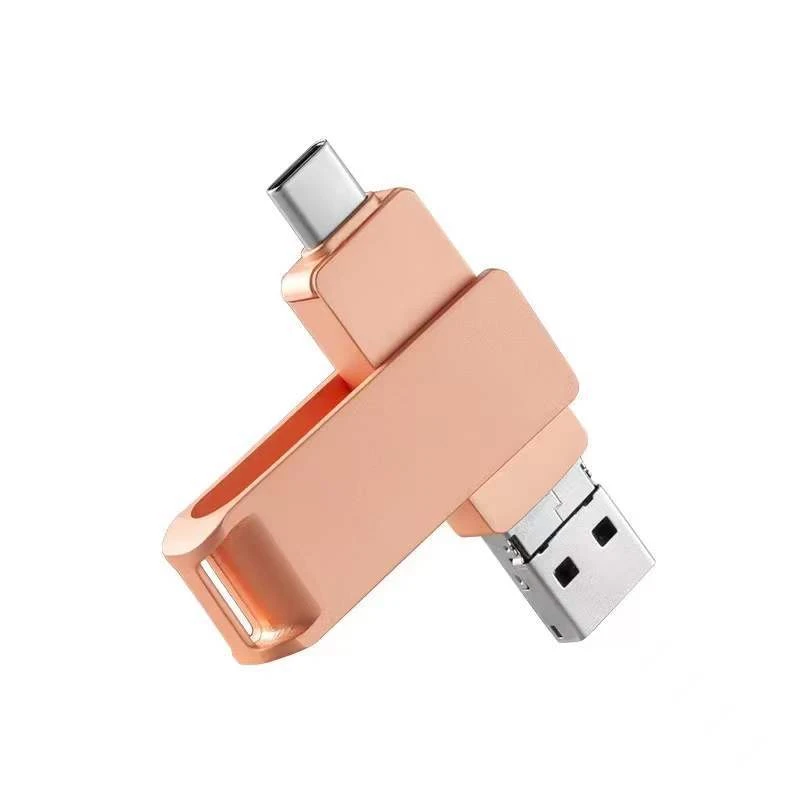
The casing material is also an important reference indicator. Metal casings typically offer better mechanical strength, heat dissipation, and electromagnetic shielding performance, suitable for industrial, outdoor, or high-protection scenarios; engineering plastic casings are lighter, offer greater design flexibility, and are sufficient for regular office and home use. For applications requiring high drop and scratch resistance, prioritize models made of reinforced metal or composite materials. Furthermore, the sealing design is crucial for waterproofing and dustproofing; some products incorporate silicone rings or special coatings at expansion joints to enhance environmental adaptability.
Storage performance and security are equally important. Pay attention to the flash memory type and available capacity markings, prioritizing clearly labeled and reputable brand-name chips to avoid data risks from falsely advertised capacities or inferior chips. For applications involving sensitive information, choose models with built-in hardware encryption or software encryption support, and verify the strength and implementation of the encryption algorithm. The quality of wear leveling and bad block management algorithms also affects long-term stability; consult technical specifications or third-party reviews to understand firmware quality.
Finally, consider price and after-sales support. While meeting performance and quality requirements, select a product with a suitable price-performance ratio within your budget, paying attention to the manufacturer's warranty period and after-sales response capabilities to ensure timely support during use.
In conclusion, the selection of a retractable USB flash drive should be comprehensively evaluated from the dimensions of interface performance, reliability of the retractable mechanism, materials and protection, storage security and cost-effectiveness. A rational decision should be made in combination with the actual application scenario to achieve the best balance between portability, durability and efficiency, and provide a solid guarantee for daily data management and cross-platform transmission.


